
13F amendments: replacing a report or adding previously omitted holdings
13F restatements and additions need different dataset operations. Exact Citadel and HBK filings show reporting-period and entry-count boundaries.
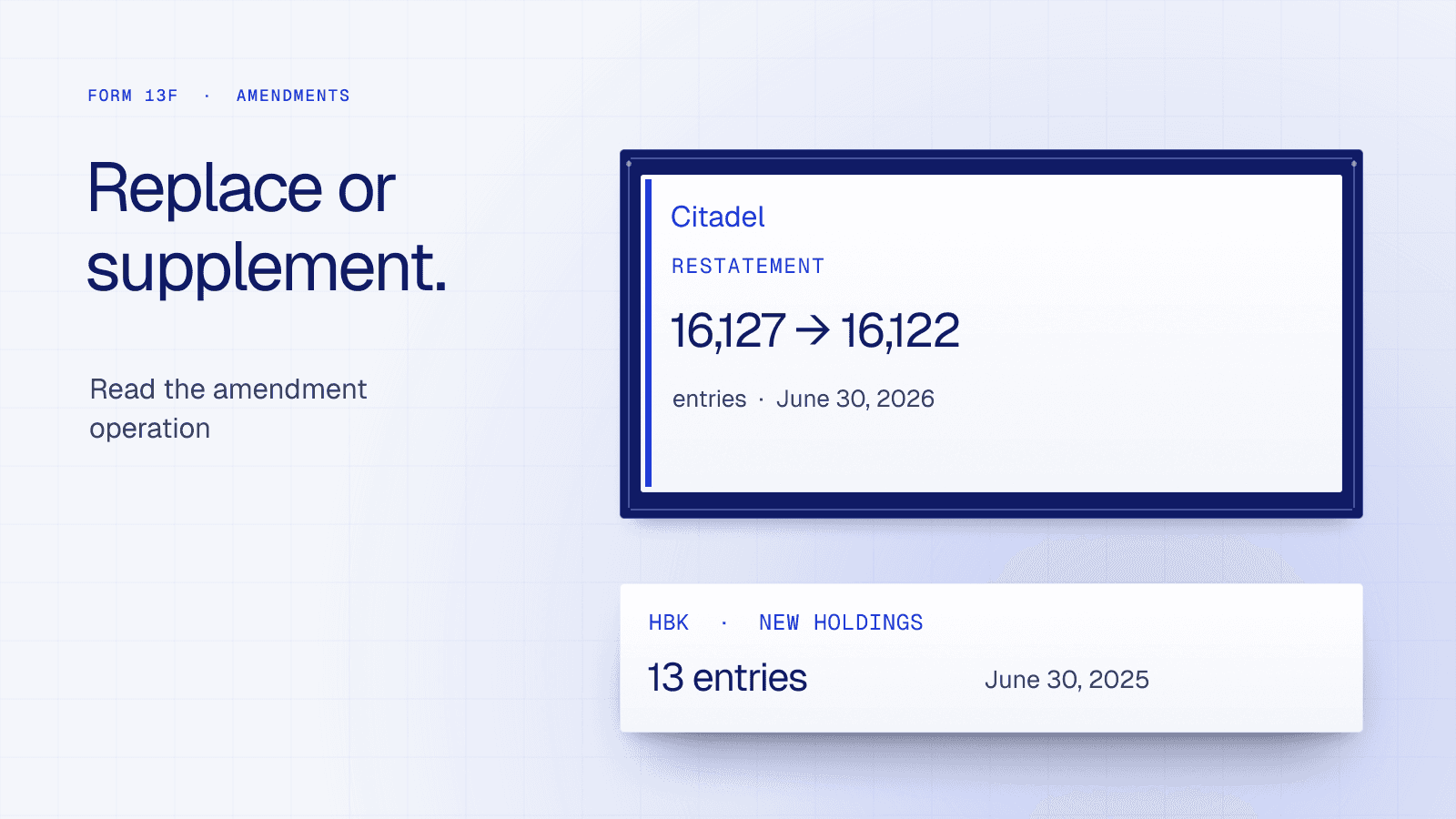
A holdings dataset needs to know what an amendment does before incorporating its rows. A restatement replaces an earlier report for the same quarter. A new-holdings amendment supplements a report with entries that were absent from the public filing. Treating both operations as an append creates different kinds of errors.
Two original SEC examples make the distinction useful for research: Citadel Advisors' September 2026 restatement of its June report, and an HBK Investments amendment filed in August 2026 for June 2025. Read the filing date separately from the holdings period and amendment operation stated on the cover page.
Citadel: the same quarter, a revised table
Citadel Advisors' original report, accession 0001104659-26-097200, was filed August 14, 2026. It reports the quarter ended June 30, 2026 and an information-table entry total of 16,127.
The firm's September 2 amendment, accession 0001104659-26-104387, retains that June 30 reporting period. It is amendment number one, marked RESTATEMENT, with an entry total of 16,122.
The amended table contains five fewer reported entries. That is a comparison of filing versions, not evidence that five securities were sold between August and September. Both documents describe the same quarter-end. An investor's trading history cannot be reconstructed from this difference in entry counts.
For a dataset representing this quarter as amended, the restatement supersedes the original version. Appending both complete tables would retain two versions of the same quarterly report. Keeping the original as historical evidence is still useful; counting it as an additional current table answers a different question.
HBK: a later filing about an earlier year
HBK Investments' August 14, 2026 amendment, accession 0001011443-26-000016, reports the quarter ended June 30, 2025. It is amendment number one and is marked NEW HOLDINGS. Its summary reports 13 information-table entries.
The document's 2026 filing date does not turn those entries into 2026 purchases. Nor does the phrase new holdings, in this amendment context, establish that they were newly purchased around the filing date. It identifies entries added to a public report for the stated historical period.
This review has not reconstructed HBK's complete June 2025 filing chain. The 13-entry amendment is therefore not presented as the complete portfolio, and its total is not added to an unverified base report. The evidence supports its amendment type, reporting period and own entry count.
The SEC explains the two operations
The SEC's Form 13F staff FAQ, questions 58(b) and 58(c), provides the relevant distinction. For a correction by restatement, the manager resubmits the entire corrected filing, which supersedes the original. For an amendment adding omitted securities, the amendment contains only the added securities and supplements the original filing.
The guidance also addresses cases needing both operations: separate amendments can be required, one restating errors and another adding omitted holdings. Selecting the newest accession and discarding every other document without reading its type can therefore lose relevant entries.
The FAQ says an amendment's summary reflects the information in that amendment. A summary total attached to a supplemental amendment should consequently not be assumed to represent the manager's whole quarterly table. This is a reporting-scope issue before it is an arithmetic issue.
A practical version record
Preserve the filing manager's identifier, reporting quarter, accession, filing date, amendment number and amendment type as separate fields. Retain the original documents and make the relationship between report versions explicit.
For a restatement, use the replacement table for the report version being reconstructed. For an additions amendment, retain its relationship to the appropriate base and other relevant amendments. Resolve missing documents before publishing a complete reconstructed total. Never interpret an amendment's publication date as the date of a trade.
These examples concern two named managers and specific archived reports, checked on October 15, 2026. They do not establish either manager's present portfolio or a complete history of subsequent amendments. They show why a useful holdings record must retain document semantics alongside the numbers. The Altss OSINT methodology provides broader context for preserving public-source evidence.


See the allocators behind your next close.
Public records carry source-specific dates where available. No population-wide measured refresh cadence or universal verification deadline is established here. Page modified, source captured, fact observed, entity verified and aggregate measured describe different events. Check the date attached to the relevant claim; a missing verification date means unknown. Stored source history does not establish a customer-facing historical-analysis interface.