
13F option rows: reported underlying value is not the option premium
Two Citadel option rows show why reported underlying-security values and SH quantities do not disclose premiums, contract counts or net economic exposure.
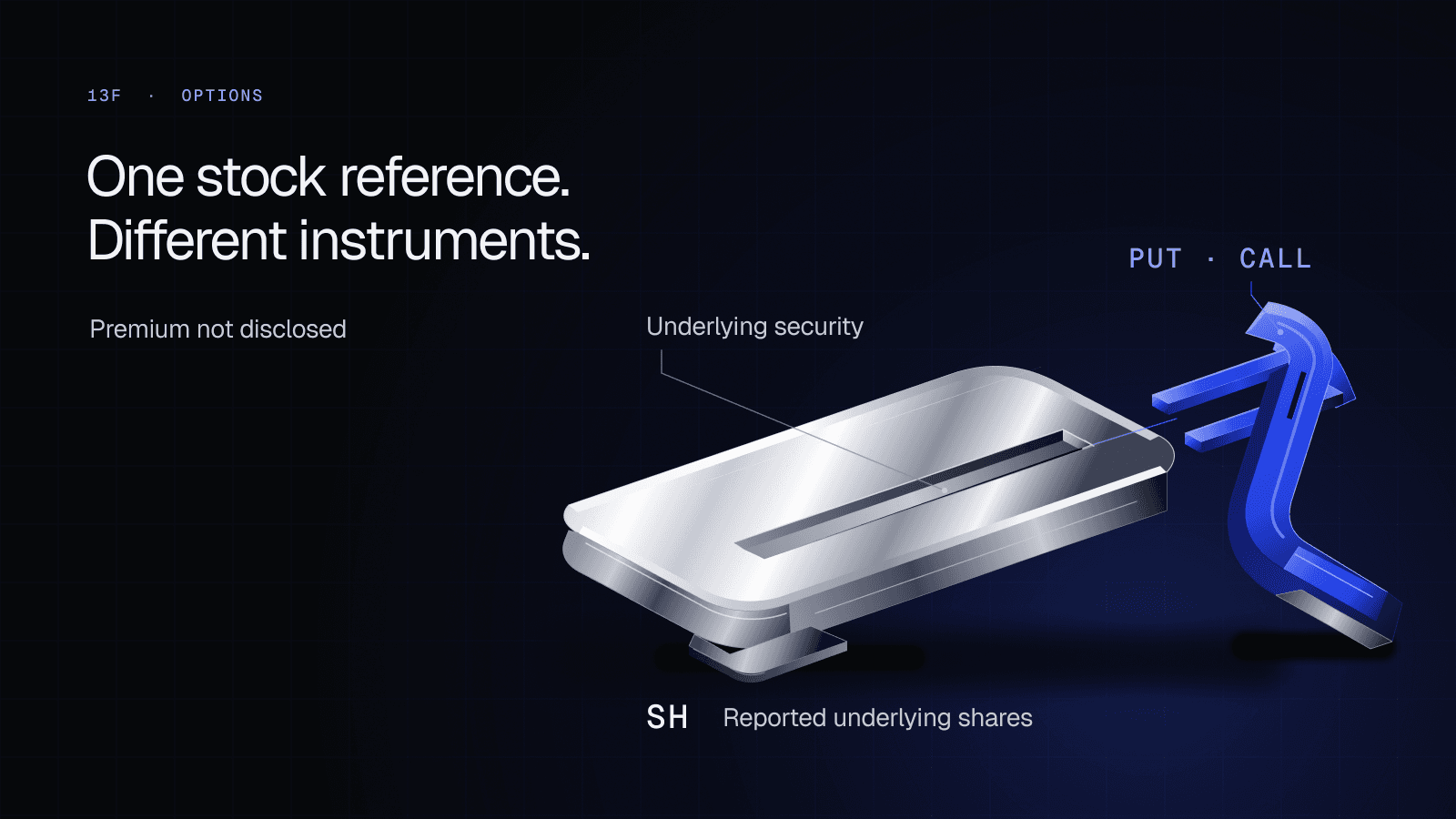
Citadel’s restated June 30, 2026 report assigns $5,758,668 to a 10x Genomics call row and $1,414,746 to a put row. Those reported values describe the securities underlying the options. They do not disclose what Citadel paid for the contracts, and their difference does not establish its net exposure.
For a manager-research team, the distinction changes what a holdings screen can say. Treating these values as option premiums would turn the report into an apparent record of capital spent. Treating the call-minus-put difference as a directional position would add a risk interpretation that the disclosed fields cannot support.
One security, two instrument designations
The September 2, 2026 cover, accession 0001104659-26-104387, identifies a Citadel Advisors restatement for June 30. The two dates describe a filing and its reporting period; neither supplies a purchase date for an option.
In the restated information table, both selected option rows name 10X GENOMICS INC, class CL A COM, CUSIP 88025U109. The call row pairs its $5,758,668 value with 150,200 shares. The put row pairs $1,414,746 with 36,900 shares. Both quantity types are SH.
The SEC staff’s Form 13F column guidance, in question 44, explains the structure: most option entries refer to the underlying security, while PUT or CALL identifies the option. The underlying stock’s class and CUSIP therefore do not make an option row an ordinary share holding.
That matters when grouping a table by issuer. The same Citadel table also contains rows for this CUSIP without a put/call designation. Collapsing those records into one undifferentiated value would erase the distinction between the reported instruments. Keep the designation with the security identifiers and quantity type.
The matching ratio is a column check
Dividing $5,758,668 by 150,200 and $1,414,746 by 36,900 produces the same $38.34 per reported underlying share. That is reproducible arithmetic on these rows, rather than an independently obtained market quote or an option-price calculation. SEC FAQ 36 confirms that the current value presentation uses nearest US dollars; the figures should not be multiplied by the former thousands convention.
The share denominator also needs its own label. SH is not a disclosed number of option contracts. Converting it into contracts would require a contract specification or multiplier that these rows do not supply. An analyst should retain the reported underlying-share quantity instead of silently changing its unit.
Neither row provides a strike price, expiry, premium paid or option delta. Even though both refer to the same underlying class, their contracts cannot be treated as economically interchangeable on that basis. Subtracting one reported value from the other does not adjust for their different terms or establish delta-adjusted risk.
The public table leaves part of the book outside view
SEC FAQ 43 supplies a further constraint: held put or call options on the official list may be reported, while written options should not be reported. Short equity positions are also excluded and are not subtracted from a long position in the same issuer. The displayed rows therefore cannot reconstruct a complete long-and-short derivatives book.
For an allocator evaluating a manager, these are observations of reported instruments at June 30. A larger displayed call value does not, by itself, establish a larger premium outlay, stronger conviction or a current willingness to add risk. Those judgments need evidence about the contracts and wider portfolio beyond this public snapshot.
A comparable research record retains the manager, accession, quarter, underlying identifiers, put/call designation, SH quantity and reported value together. Before comparing another quarter, resolve the filing version as well: the Citadel and HBK amendment analysis explains why a restatement replaces a report while an additions amendment supplements it. Preserving both the report operation and instrument identity keeps a holdings comparison from becoming an unsupported claim about trades or exposure.