
Amazon and Meta’s server-life estimates moved earnings in opposite directions
Opposite 2025 depreciation revisions at Amazon and Meta show why equipment cohorts, reported earnings and cash capital requirements need separate analysis.
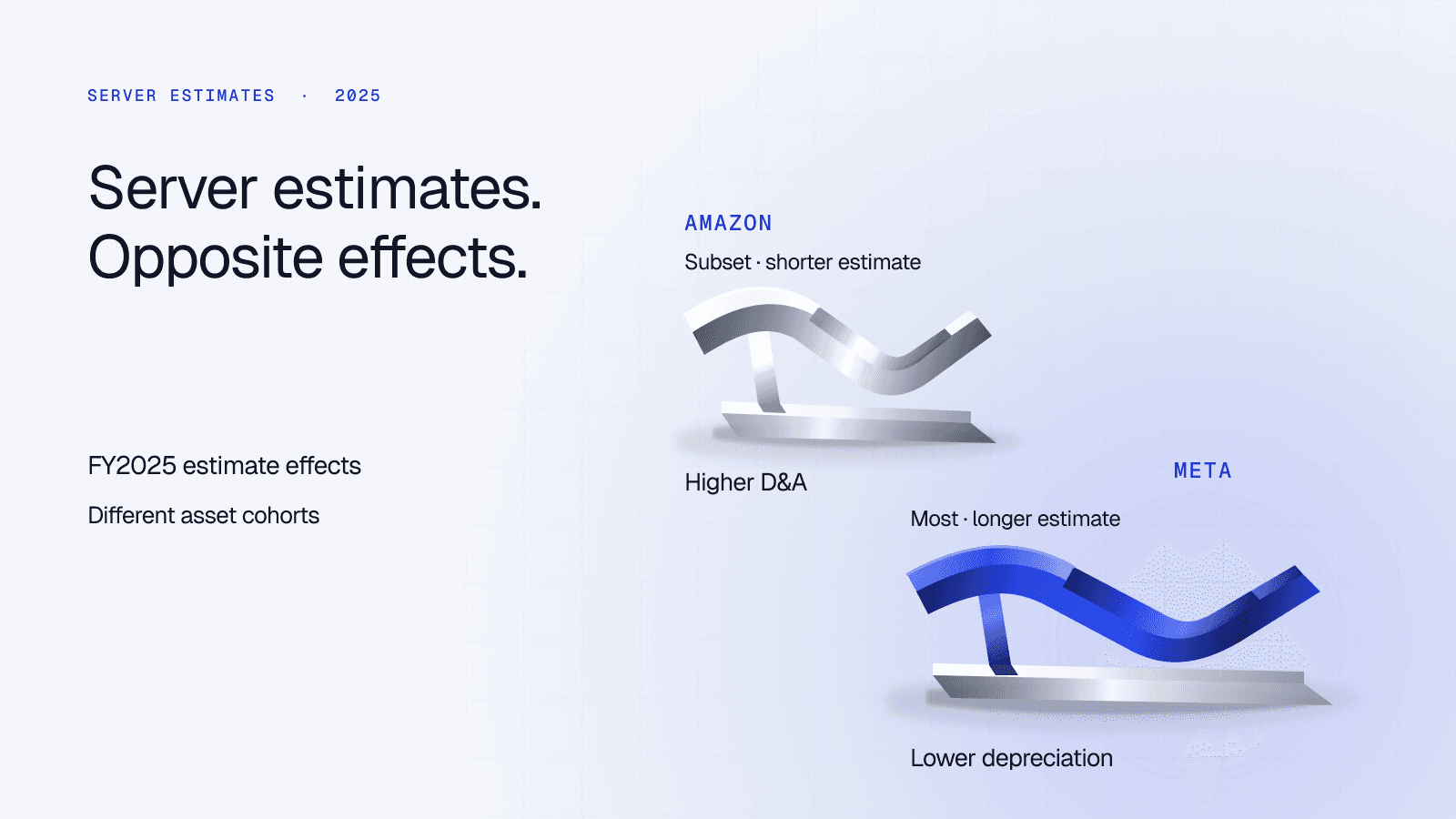
Amazon shortened the estimated useful life of some servers and networking equipment, adding $1.4 billion to its 2025 depreciation and amortization expense. Meta extended the estimated life of most servers and network assets to 5.5 years, reducing its 2025 depreciation expense by $2.92 billion. Both changes took effect on January 1, 2025.
Those opposite decisions matter to infrastructure and private-credit investors assessing the earnings of a customer or counterparty. They change how equipment costs pass through reported profit. Understanding the capital requirements behind that profit calls for a further bridge to purchases, financing payments and the assets likely to need replacement.
Two changes, different asset cohorts
Amazon’s 2025 annual report describes a reduction from six years to five for a subset of its servers and networking equipment. It attributes the shorter estimate to faster technological development, particularly in artificial intelligence and machine learning. The disclosed expense effect primarily affected AWS.
Amazon measured the $1.4 billion increase using the relevant equipment included in property and equipment at December 31, 2024 and equipment acquired during 2025. It also reported a $1.0 billion reduction in net income from the change. Its year-end policy table retained a five-to-six-year range for servers and networking equipment: the revision covered a subset of that class.
Meta’s annual report describes an increase to 5.5 years for most servers and network assets. Its $2.92 billion depreciation reduction and $2.59 billion net-income increase were calculated using equipment placed in service by December 31, 2024. That is a different cohort basis from Amazon’s inclusion of 2025 acquisitions.
Meta’s disclosure supplies the new estimate without specifying one previous life for every affected asset. Its year-end policy range was five to 5.5 years. Converting that range into a claim that every asset moved from five to 5.5 would erase the distinction between a class-wide policy range and the particular equipment reassessed.
The companies therefore offer two useful cases of management estimates affecting earnings, with different directions, asset populations and stated expense measures. Their reported effects cannot be combined into a common fleet adjustment. These are January 2025 changes and full-year 2025 effects, not announcements of new third-quarter 2026 policies.
Meta’s server depreciation still increased
An estimate-change benefit measures an effect relative to the earlier estimate. The actual expense recorded during a year also reflects the equipment being depreciated. Meta’s annual report makes the distinction concrete: server and network-asset depreciation reached $13.36 billion in 2025, compared with $11.34 billion in 2024, alongside the separately disclosed $2.92 billion reduction attributable to its estimate change.
The later June 2026 quarterly report reported $9.01 billion of server and network-asset depreciation for the first half, compared with $5.74 billion in the first half of 2025. Those are actual period expenses. They should stay separate from the annual report’s calculation of the earlier estimate-change effect.
For an underwriter, reversing a disclosed benefit and projecting the resulting number forward would leave the asset roll-forward unresolved. The relevant questions include which equipment entered service, what remained in the depreciable base and how the remaining costs are allocated. Meta applies revised useful lives prospectively to remaining carrying amounts; its policy also identifies technological advances and planned asset use as reasons actual useful lives can differ from estimates.
Build the cash bridge separately
Meta reported $50.92 billion of capital expenditures for the first half of 2026, including property-and-equipment purchases and principal payments on finance leases. That measure answers a capital-spending question; its server-depreciation expense answers an accounting-allocation question. The quarterly operating-cash-flow discussion separately identifies depreciation and amortization among the non-cash adjustments to net income.
The same distinction applies when comparing counterparties. The Microsoft lease and capex case explains why lease classification, asset life and payment timing can produce different investment measures. Preserve each company’s stated inclusions before comparing its figures. Cash-tax movements also need their own explanation, rather than an assumption that a book-estimate change leaves every cash flow unchanged.
Useful-life disclosures help assess the sensitivity of reported earnings to management estimates. They supply a starting assumption for the equipment-cost schedule, not a universal physical lifespan for GPUs, a resale-value forecast or a contractual replacement date. For a project loan or infrastructure investment, model equipment replacement, cash purchases and financing payments on their own schedules.