
CalPERS at the TPA transition: commitments and liquidity
CalPERS’ FY2025–26 reports connect private-market commitments, funding liquidity and the shift to TPA, showing how a mandate fits the whole fund.
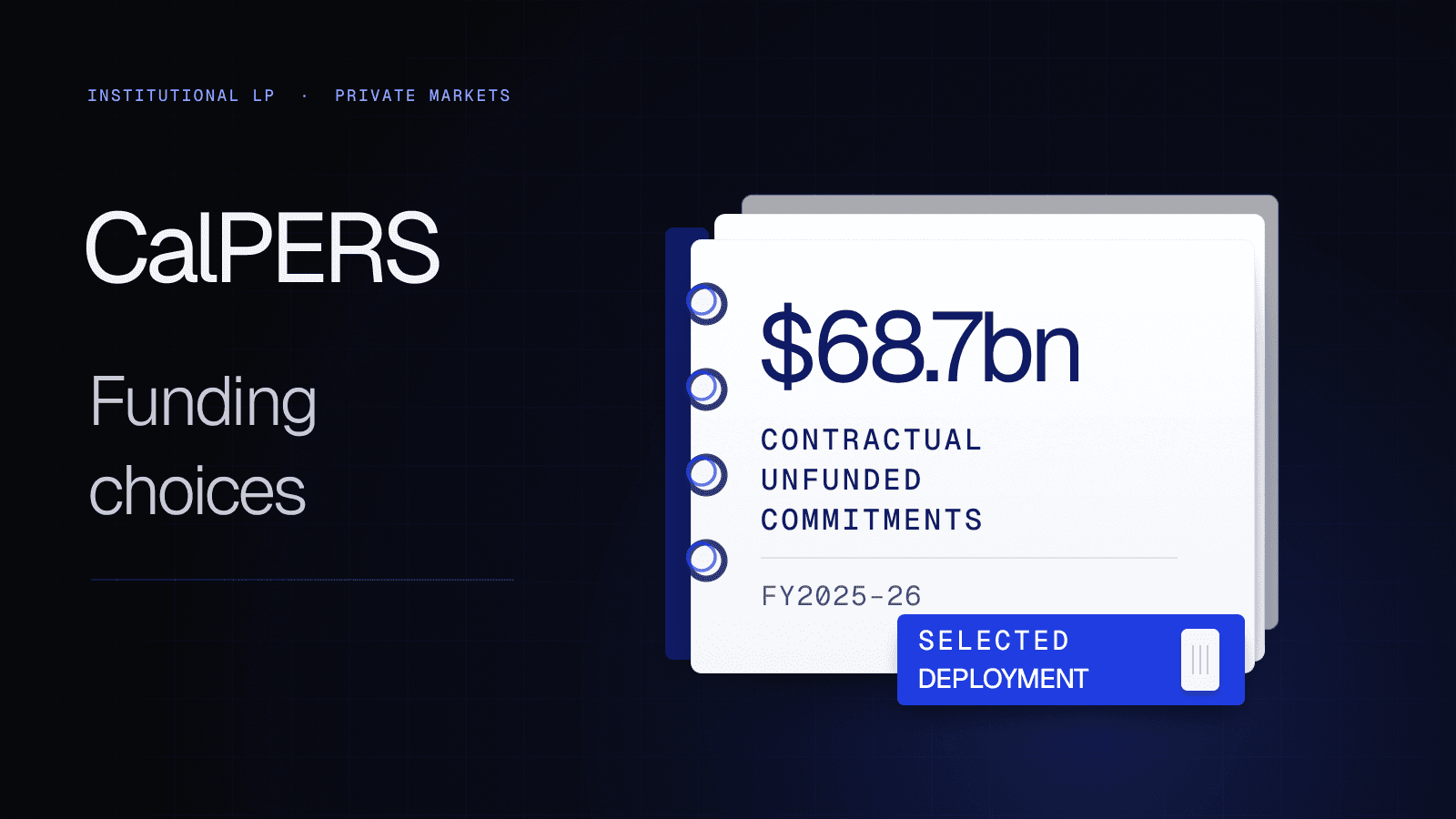
CalPERS reported $20.4 billion of net capital deployed into private-market programmes during FY2025–26 and ended the year with $68.7 billion of contractual unfunded commitments. Its September trust review explains how it supports those obligations: capacity in sellable reference-portfolio and other public assets, allowing for expected capital calls and uncertainty in offsetting distributions.
The funding arrangement matters as much as the commitment total. External fund obligations create future calls that CalPERS says it has little ability to influence. Other deployment channels can leave more discretion with the pension. A proposed investment therefore needs a case for how it fits the portfolio’s funding process as well as its desired exposure.
That question acquired a new context when CalPERS implemented its Total Portfolio Approach, or TPA, on July 1, 2026. The September reviews describe the fiscal year that ended immediately before the transition. They show the starting portfolio and its implementation choices, rather than results attributable to TPA.
Funding calls while preserving investment choice
In its September trust-level review, pages 17–18, staff distinguishes the year’s net capital deployment from the obligations still outstanding. The $20.4 billion is contributions minus distributions. The $68.7 billion is a fiscal-year-end stock of contractual unfunded commitments, primarily obligations incurred as a limited partner in externally managed funds.
Those obligations represent a potential future draw on liquidity over which CalPERS has little or no influence. Staff describes retaining sufficient capacity in sellable assets to meet expected calls, with a buffer for uncertainty about distributions coming back from private investments. Distributions from existing investments and the liquidity retained elsewhere in the portfolio are connected parts of that funding decision.
Contractual unfunded commitments capture only part of possible future deployment. The same review describes annual revocable allocations to real-estate separately managed accounts. It also identifies co-investment capital whose deployment CalPERS controls. These arrangements can give the institution a different pacing decision from an external fund call.
For a GP, the distinction changes what a funding proposal should explain. A commitment request needs a drawdown profile and a clear account of when the LP becomes obligated. An opportunity whose execution remains at the pension’s discretion needs to explain the decision it is asking the investor to make. Calling both proposals private-market exposure leaves the funding mechanics unresolved.
The figures also describe different sources of portfolio growth. Staff reports that private-programme investments increased by $45 billion after valuation changes were included. That is a different measure from the $20.4 billion of net capital deployed. It cannot be used as an estimate of the year’s new fund subscriptions.
What the year’s commitment activity actually built
Meketa, CalPERS’ board private-equity consultant, reports $26.1 billion of net new PE commitments over the twelve months ended June 30, 2026. Its September PE review, pages 4–5, describes additions to growth, venture and mid-market buyout strategies alongside the existing large- and mega-buyout exposure. It also identifies lower-cost investment structures as part of implementation.
The private-debt programme followed its own route. Meketa’s September private-debt review, pages 3–4, records $12.9 billion of new commitments over the same twelve months: $7.5 billion across twelve customized investment accounts and $5.4 billion across six fund commitments. These are commitment figures, distinct from the trust-level net-deployment measure.
The account channel was the larger component of that reported mix. More revealing for a prospective manager is the distinction between initial commitments and additions: the review classifies 53% as upsizes to existing commitments. It also counts a co-investment commitment in an existing strategy as an initial commitment. An initial commitment record therefore need not identify a first-time GP relationship.
Programme expansion can deepen an existing account, add exposure within a known strategy or create a new relationship. The capital total does not identify which of those decisions a competing manager is addressing. Altss’ September pension mandate comparison develops that relationship-level question across selected plans. CalPERS’ reports add the portfolio-level funding context around it.
TPA changes the investment case behind the allocation
The historical allocation tables need to be read in that transition. CalPERS’ staff review says the portfolio was managed under Strategic Asset Allocation through June 30. Its interim-target display is presented to close out reporting under that framework.
The CIO’s discussion on page 3 describes TPA as evaluating strategies for their potential benefit to the entire fund. A reference portfolio of 75% global equities and 25% US Treasury bonds provides the comparison for assessing investment value creation.
That reference portfolio gives a manager a broader proposition to address: the exposure, return opportunity, liquidity demands and costs the investment brings to the total fund. A historical asset-class target gap cannot establish how much capital is currently available for a new mandate. It leaves out both the changed decision framework and the obligations the portfolio must already support.
Implementation belongs in that proposition. The investor can examine who selects the investments, who approves deployment and how much discretion the proposed vehicle leaves with it. The related distinction between selecting a co-investment manager and presenting a company investment helps a GP identify what kind of capital decision it is seeking.
The proposal can make the funding choices explicit: how much capital becomes contractually committed, what deployment decisions remain with the investor, and how expected calls and distributions fit its wider liquidity plan. For a pooled-fund commitment, the manager can set out its drawdown assumptions and the circumstances that would change them. For an arrangement offering more discretion, it can identify which decisions require the investor’s approval and when. Those details give CalPERS a funding proposition to assess alongside the investment case.


See the allocators behind your next close.
Public records carry source-specific dates where available. No population-wide measured refresh cadence or universal verification deadline is established here. Page modified, source captured, fact observed, entity verified and aggregate measured describe different events. Check the date attached to the relevant claim; a missing verification date means unknown. Stored source history does not establish a customer-facing historical-analysis interface.