
CalSTRS investment commitments: portfolio sponsors and approval authority
CalSTRS’s H1 2026 commitments and public policies distinguish internal sponsors, named GP relationships and approval of commitments from later funding.
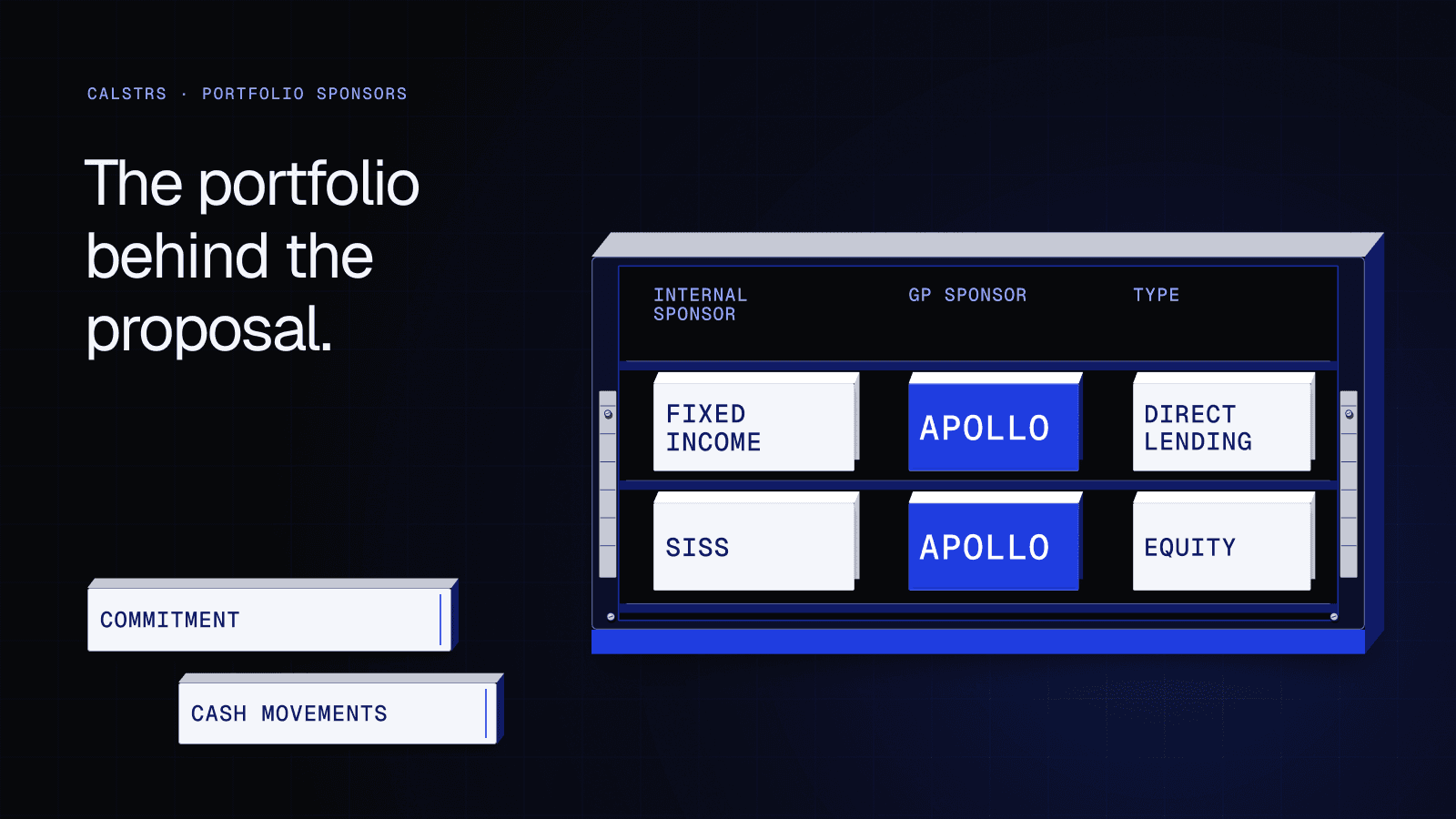
CalSTRS’s first-half 2026 Collaborative Strategies report lists two commitments with Apollo Global Management as GP sponsor. Fixed Income sponsored a $10 million direct-lending investment; Sustainable Investment and Stewardship Strategies (SISS) sponsored a $94 million equity investment. Both sit in financials, but the internal sponsor and investment type differ.
For a GP bringing a transaction to CalSTRS, that distinction makes portfolio fit part of the investment proposition. A manager relationship alone does not explain which team should sponsor an opportunity, what the capital will finance or which commitment framework applies.
One manager relationship can reach different portfolios
The June 30 staff report records seven commitments totaling $509 million in Collaborative Strategies’ Opportunities (CSO) sleeve during the first half. Its table separates the asset-class sponsor from the GP sponsor. Private Equity sponsored a $100 million technology-equity investment with Tiger Global Management, while Real Estate sponsored a $235 million real-estate equity investment with Blackrock.
The sleeve gives asset classes a place for opportunities that do not fit cleanly within their existing portfolios. CalSTRS’s Collaborative Strategies policy identifies differing risk and return projections, duration, allocation restraints and diversification goals as reasons an investment might sit there. It can span public and private assets.
An internal sponsor therefore conveys more than a contact name. It places a proposed investment within a portfolio problem. A GP should explain the instrument, the expected holding period and the risk it adds or diversifies, then connect those features to the proposed portfolio home. The Private Equity policy itself directs staff to consult other asset classes and the CIO when their mandates overlap.
The separate Private Equity activity report lists named co-investment commitments, including $100 million to Lincoln Co-Invest I, L.P., sponsored by Francisco Partners. These are a different schedule from the CSO opportunities. A relationship assessment should retain the portfolio, vehicle and investment type attached to each entry, rather than treating every transaction alongside a manager as the same programme.
That is the plan-specific extension of the distinction between pooled co-investment programmes and company-capital decisions. The GP’s name is one part of the relationship; the capital proposition has its own portfolio and implementation requirements.
Commitment authority follows the investment route
The Collaborative Strategies policy gives the CIO or designee authority to approve commitments up to 1% of net total fund assets at the time of commitment. Investments remain subject to appropriate due diligence and an affirmative staff recommendation, with an independent fiduciary where required. The percentage is an authority limit, not an estimate of capital currently available to a manager.
The Private Equity policy delegates investment management to staff within its boundaries and relevant guidelines. Every PE investment requires a positive written staff recommendation. Co-investments greater than $250 million also require a positive recommendation from a Program Advisor, Independent Fiduciary or Co-investment Advisor.
For a PE co-investment in a single company or related companies, the policy limits the commitment to 2% of PE NAV, whether made at one time or over time, and limits CalSTRS to 50% of a financing round. Those measures use a different portfolio denominator from Collaborative Strategies’ total-fund limit. Pooled partnerships and separately managed accounts have their own restrictions. A proposal’s legal form and underlying exposure therefore matter alongside its headline size.
This changes what a useful deal presentation contains. It should specify the proposed vehicle, CalSTRS’s commitment, the financing round and any related exposure already held. The recommendation and size tests can then be considered within the relevant portfolio framework, rather than inferred from a general pension cheque-size range.
Releasing cash is a later decision
CalSTRS’s September 23 delegation review distinguishes private-asset commitment authority from cash movements that fulfil contractual obligations. Its approval-limit attachment expressly says the private-asset cash structure concerns previously approved commitments and excludes authorization of new investments.
A cash-approval title or limit consequently cannot substitute for the investment decision. This is the practical counterpart to the approval boundaries in other pension records: identify what decision a particular authority actually covers.
The selected historical commitments and policies do not establish a current open mandate.


See the allocators behind your next close.
Public records carry source-specific dates where available. No population-wide measured refresh cadence or universal verification deadline is established here. Page modified, source captured, fact observed, entity verified and aggregate measured describe different events. Check the date attached to the relevant claim; a missing verification date means unknown. Stored source history does not establish a customer-facing historical-analysis interface.