
KIRKBI capital allocation: climate ownership and financial assets
KIRKBI Climate owns businesses and invests in specialist funds. Separate its five-year plan from the DKK 81 billion financial portfolio and historical capital uses.
KIRKBI Climate's September 2026 plan to invest an additional DKK 10 billion over five years sits alongside a different pool: KIRKBI Investment Management's DKK 81 billion financial portfolio, measured at the end of 2025. Those amounts describe different mandates, entities and periods. Neither is a disclosed amount currently available for a new external fund commitment.
The distinction is more nuanced than a company investor on one side and a fund allocator on the other. KIRKBI Climate owns operating businesses, including Adapture Renewables, but its annual-report portfolio also names specialist fund investments. Investment Management separately describes buyout funds and co-investments among its financial investment routes. A climate developer and a fund manager therefore need to understand the relevant business and form of capital, rather than start from a single family-office AUM figure.
KIRKBI is the Kirk Kristiansen family's ultimate holding company. Its 2025 annual report, published with the March 26, 2026 results, explains the new structure and supplies the historical financial comparison below. The September plan and July project announcement are later disclosures with their own scope; they do not update every year-end balance to October 2026.
The financial portfolio has a defined role and perimeter
KIRKBI's group structure gathers its activities in LEGO Holding, KIRKBI Climate and KIRKBI Education, alongside the financial investment portfolio. The business areas have dedicated leadership and boards. The report records KIRKBI Climate's legal establishment on January 1, 2025 and KIRKBI Investment Management's establishment as a separate legal entity on January 1, 2026. The latter was formerly known as Financial Investments.
Investment Management's portfolio was valued at DKK 81 billion at the end of 2025, compared with DKK 79 billion a year earlier. Its mandate covers equities, real estate and fixed income. The amount is a portfolio stock, with several investment routes inside it, rather than a cash balance or a new fundraising program.
The current official portfolio descriptions make those routes explicit. Direct Equity pursues active ownership of significant minority stakes in listed and private companies. Private Equity includes buyout funds and co-investments. Venture Capital includes funds focused on seed through Series C/D financing, as well as direct minority investments in early-stage companies.
The same descriptions assign liquidity functions to other assets. Quoted Equity can provide liquidity to KIRKBI and related entities; Fixed Income is also used for cash management. Converting the full DKK 81 billion into an assumed private-fund allocation would erase both those roles and the investments already held. A GP's addressable opportunity cannot be sized from that stock alone.
Climate combines business ownership with specialist fund exposure
The annual report defines Climate's activities across energy transition, circular plastics and land sustainability. It describes a twofold approach: backing scalable, proven technologies through active ownership and supporting emerging technologies that require patient capital to reach scale.
Its year-end energy-transition portfolio on page 25 shows how those approaches can take different forms. Adapture Renewables is listed as wholly owned. Other company positions are labelled minority interests. Alongside those businesses, the table identifies KIRKBI Climate as an investor in Copenhagen Infrastructure Partners' Energy Transition Fund I, Decarbonization Partners Fund I and AP Ventures Fund III.
These are disclosed fund routes within the climate business itself. They prevent a simplistic classification in which every Climate exposure is a directly owned company and every fund exposure belongs to Investment Management. The named positions establish a history of using specialist funds; their presence does not disclose new commitment sizes or an open selection process for another manager.
For a GP assessing fit, the distinction is substantive. A buyout fund and a climate-technology fund can both seek commitments from family-controlled capital while offering exposure to different mandates. A project developer offering an operating asset presents a third proposition. The common ultimate owner does not make those forms of capital interchangeable.
The five-year plan describes prospective business building
KIRKBI's September 4 announcement describes Climate's transition from thematic investor to active owner helping build, scale and operate businesses. It reports a portfolio exceeding DKK 10 billion and a plan to invest an additional DKK 10 billion over five years.
The plan indicates a direction for capital and ownership effort. It does not divide that amount among company equity, specialist funds, projects or other instruments, and it does not provide a schedule of completed payments. Its business-building language therefore needs to remain attached to the amount when an allocator or manager assesses its relevance.
The preceding financial period supplies a different measure. KIRKBI's annual results report DKK 1.2 billion invested in Climate during 2025 and DKK 10.3 billion of assets for that business. Adding the five-year plan to the historical assets would combine intended future deployment with an existing asset measure. Dividing the plan into equal annual tickets would introduce a spending schedule the announcement does not supply.
Historical capital uses show why the asset stock is not a budget
Page 56 of the annual report presents cash flows in line with KIRKBI's business model, identified as internal management reporting and an alternative performance measure. The IFRS statements are presented separately. Within this specified 2025 presentation:
- DKK 13.382 billion of net cash inflows from LEGO Holding and DKK 109 million of interest and dividends total DKK 13.491 billion before tax.
- Consolidated income tax paid of DKK 5.643 billion leaves DKK 7.848 billion of reported cash inflows after tax.
- The cash-outflow categories comprise DKK 1.236 billion for Climate, DKK 587 million of head-office and support costs, DKK 6.263 billion of share buybacks and DKK 495 million of shareholder dividends.
The four outflow categories sum to DKK 8.581 billion; buybacks and shareholder dividends together account for DKK 6.758 billion of that presentation. These calculations reconcile published categories rather than reconstructing the group's full IFRS cash movement or estimating current liquidity.
They also make the capital-allocation question more concrete. The financial base supports operating investment, ownership distributions and other uses. Its size is consequently different from the amount a competing fund manager can seek. A specific mandate and a commitment decision carry more information about that opportunity than either profit or total portfolio assets, as institutional pension decisions also illustrate.
An operating milestone supplies a different kind of evidence
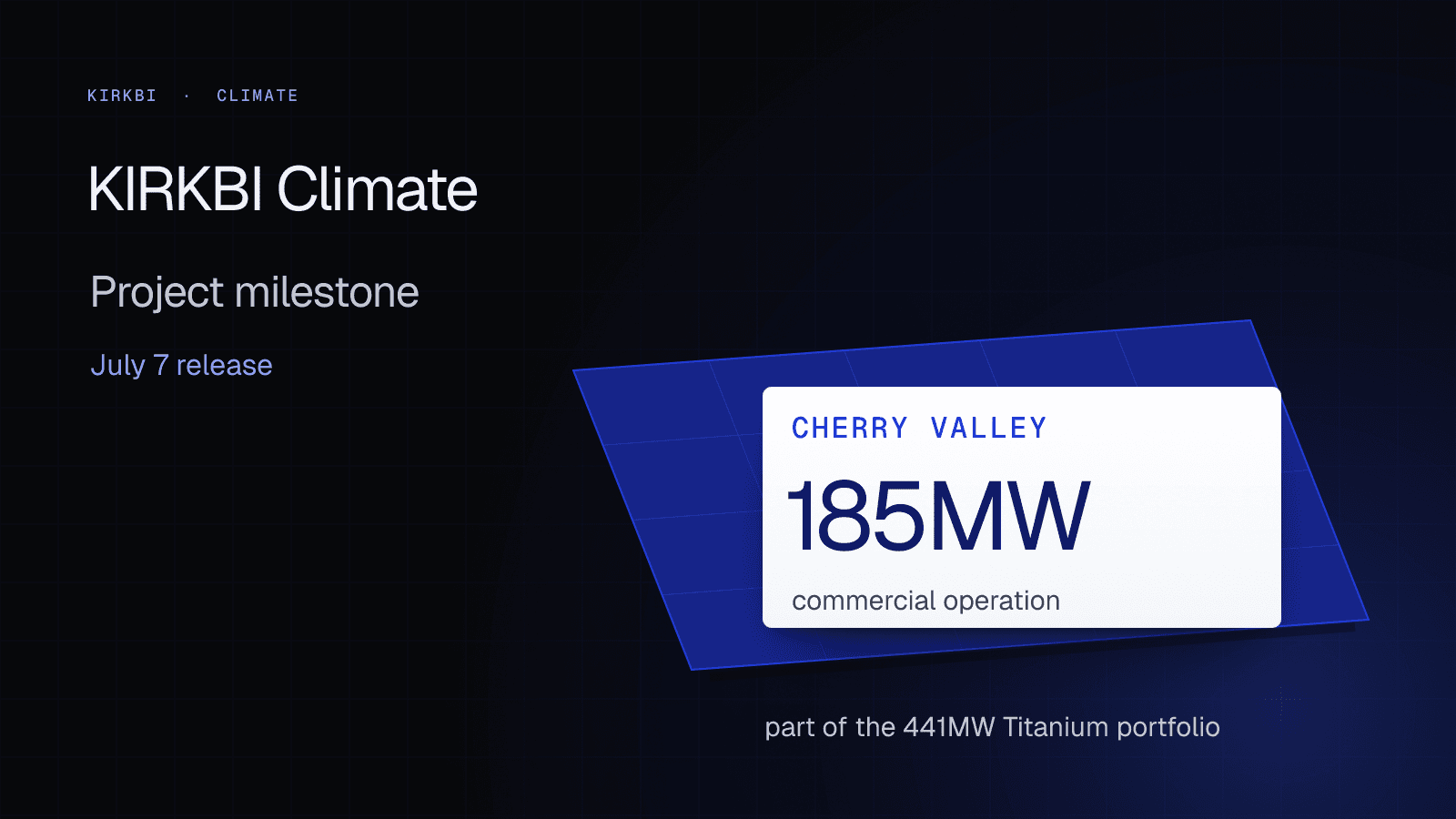
Adapture's July 7, 2026 company release reports substantial completion and commercial operation of the 185MW Cherry Valley solar project in Cross County, Arkansas. It identifies the project as the final one to achieve commercial operation within its three-site, 441MW Titanium portfolio across Arkansas and Illinois. The 185MW is included within that portfolio, rather than additional capacity to add to it.
The release says substantial completion occurred at the end of the previous year. Its July publication date is therefore not an exact date for every construction or operating milestone. Nor does it disclose a new KIRKBI equity cheque, a purchase price or a project-financing breakdown.
Commercial operation establishes delivery within an owned platform. Financing remains a separate question: the release describes what the project had achieved, without pricing the capital that brought it into service.


See the allocators behind your next close.
Public records carry source-specific dates where available. No population-wide measured refresh cadence or universal verification deadline is established here. Page modified, source captured, fact observed, entity verified and aggregate measured describe different events. Check the date attached to the relevant claim; a missing verification date means unknown. Stored source history does not establish a customer-facing historical-analysis interface.