
NMFC’s PIK income: fewer dollars, a larger share
NMFC’s Q2 2026 filing shows how PIK interest, noncash dividends and income denominators change a BDC earnings comparison.
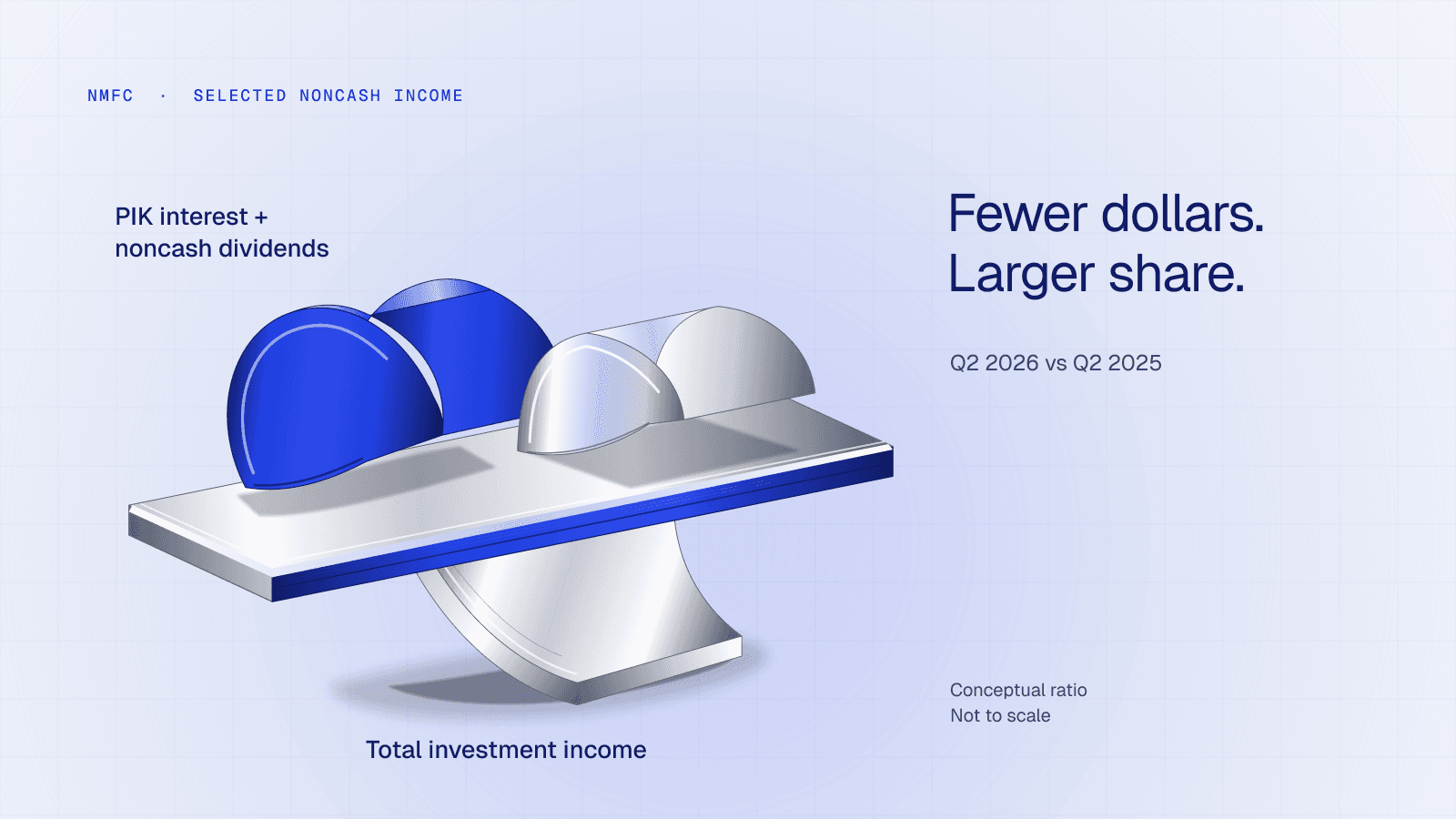
New Mountain Finance Corporation recognized $10.297 million of PIK interest and noncash dividends in the quarter ended June 30, 2026, down from $13.530 million a year earlier. Yet those items represented 16.75% of total investment income, compared with 16.21% in the earlier quarter. Income contracted faster than the selected noncash components. The higher percentage did not mean more dollars were recognized.
NMFC’s June 30 Form 10-Q also supports a narrower measure: PIK interest alone represented 8.81% of total investment income. Adding reported noncash dividends changes the question from interest accrual to the combined contribution of those two components. A BDC earnings comparison needs that choice beside the ratio. Its August 3 filing presents the June-quarter results for 2026 and 2025 in the same statement.
One issuer, three income ratios
The consolidated statement separates income from non-controlled, non-affiliated investments; non-controlled, affiliated investments; and controlled investments. Summing the PIK-interest rows across those groups gives $5.415 million for the June 2026 quarter. The noncash-dividend rows add $4.882 million. Their combined $10.297 million sits within $61.475 million of total investment income. The report presents these amounts in thousands of dollars; the figures here are converted to millions.
Three calculations describe different parts of that same quarter:
- PIK interest divided by total investment income: $5.415 million / $61.475 million = 8.81%.
- PIK interest plus noncash dividends divided by total investment income: $10.297 million / $61.475 million = 16.75%.
- PIK interest divided by total interest income: $5.415 million / $43.329 million = 12.50%.
The last denominator combines interest reported excluding PIK with PIK interest. It leaves dividends and other income outside the comparison. Total investment income includes those additional components. An analyst studying interest accrual can reasonably use the narrower pair; an analyst examining the combined income contribution of PIK interest and noncash dividends needs the broader numerator. Calling all three a PIK ratio would conceal their different coverage. None measures cash collected.
Fewer dollars, a larger share
Using the combined numerator and total investment income consistently produces this same-quarter comparison:
- Q2 2025: $6.888 million of PIK interest plus $6.642 million of noncash dividends = $13.530 million; total investment income of $83.490 million; combined share 16.21%.
- Q2 2026: $5.415 million plus $4.882 million = $10.297 million; total investment income of $61.475 million; combined share 16.75%.
The combined amount fell $3.233 million, or 23.90%, while total investment income fell 26.37%. That faster decline in the denominator explains the increase of approximately 0.54 percentage points in the combined share. The calculations use the statement’s reported dollar amounts, rather than subtracting rounded headline percentages.
The issuer supplies business context for the contraction. Its quarterly income discussion attributes the decline in interest income primarily to a lower invested asset base following the Asset Sale. It attributes the dividend-income decline primarily to fewer preferred-equity investments held. Those explanations matter when interpreting the changing income mix. The ratio movement alone does not establish a change in borrower credit quality or collectibility.
Recognition and collection remain different measures
NMFC’s accounting policy records PIK interest and dividends at contractual rates when deemed collectible. They are added to principal or share balances on capitalization dates and are generally due at maturity or when redeemed by the issuer. Recognizing that income therefore does not establish receipt of the same amount in the quarter.
Nor can the rest of total investment income automatically be called cash received. The interest-income policy includes premium and discount amortization and prepayment penalties, alongside accrual accounting. Subtracting the two selected noncash components from total investment income would leave other items whose recognition and payment timing still need to be distinguished.
The cash-flow statement deducts $26.070 million of noncash investment income in its operating reconciliation for the six months ended June 30. The selected PIK-interest and noncash-dividend accruals total $20.755 million over that half-year. The aggregate adjustment and those two components are different measures; neither supplies a Q2 PIK collection figure or a same-period recovery rate.
For a cross-BDC income comparison, NMFC’s figures demonstrate why a percentage needs its component rows, denominator and reporting period intact. Its broader share rose while the associated dollars fell. Comparing that share with another issuer’s interest-only measure would introduce a definition change before any difference in credit performance had been established.