
Ferd’s fund mandates: strategy fit, reference returns and reporting currency
Ferd’s 2025 fund disclosures separate mandate roles, reference-index performance and USD/NOK reporting, with a distinct climate fund and co-investment route.
Ferd’s Global Equity mandate returned 19.0% in US dollars in 2025 and still trailed its weighted reference index. For a fund manager assessing Ferd as a prospective investor, that result puts a specific question ahead of the group’s wealth: what would the strategy contribute to the relevant mandate?
The 2025 annual report describes several routes into fund relationships. External Managers selects equity and absolute-return funds to complement direct investments. Impact Investing primarily uses funds and also co-invests with its managers. The distinction gives a prospective manager a more precise starting point than the size of the family-owned group. The figures below cover 2025 performance and year-end exposures.
A strong absolute return can miss the mandate’s reference
Global Equity invests in equity funds that complement Ferd’s direct investments. Its 19.0% USD return fell below its own weighted reference index. Ferd attributes the shortfall mainly to weak relative results in the US Centric and technology themes, with style biases and market concentration among the meaningful factors.
A positive return therefore leaves a manager-selection question open. A proposed strategy needs to explain its exposures alongside the mandate’s reference and existing direct holdings. The report does not specify the weighted index sufficiently to calculate the shortfall; the nearby MSCI World return should not be substituted for it.
Global Fund Opportunities has a different job: attractive absolute returns with lower correlation to stock-market developments than ordinary equity funds. It combines liquid and illiquid investments. The mandate returned 12.8% in 2025, with 13.7% from liquid investments and 11.8% from illiquid investments, within the area’s USD reporting basis.
These objectives call for different manager propositions. Equity-relative performance belongs in the Global Equity discussion; an absolute-return strategy needs to explain how its return drivers fit the lower-correlation purpose of Global Fund Opportunities.
The same fund book produced different currency results
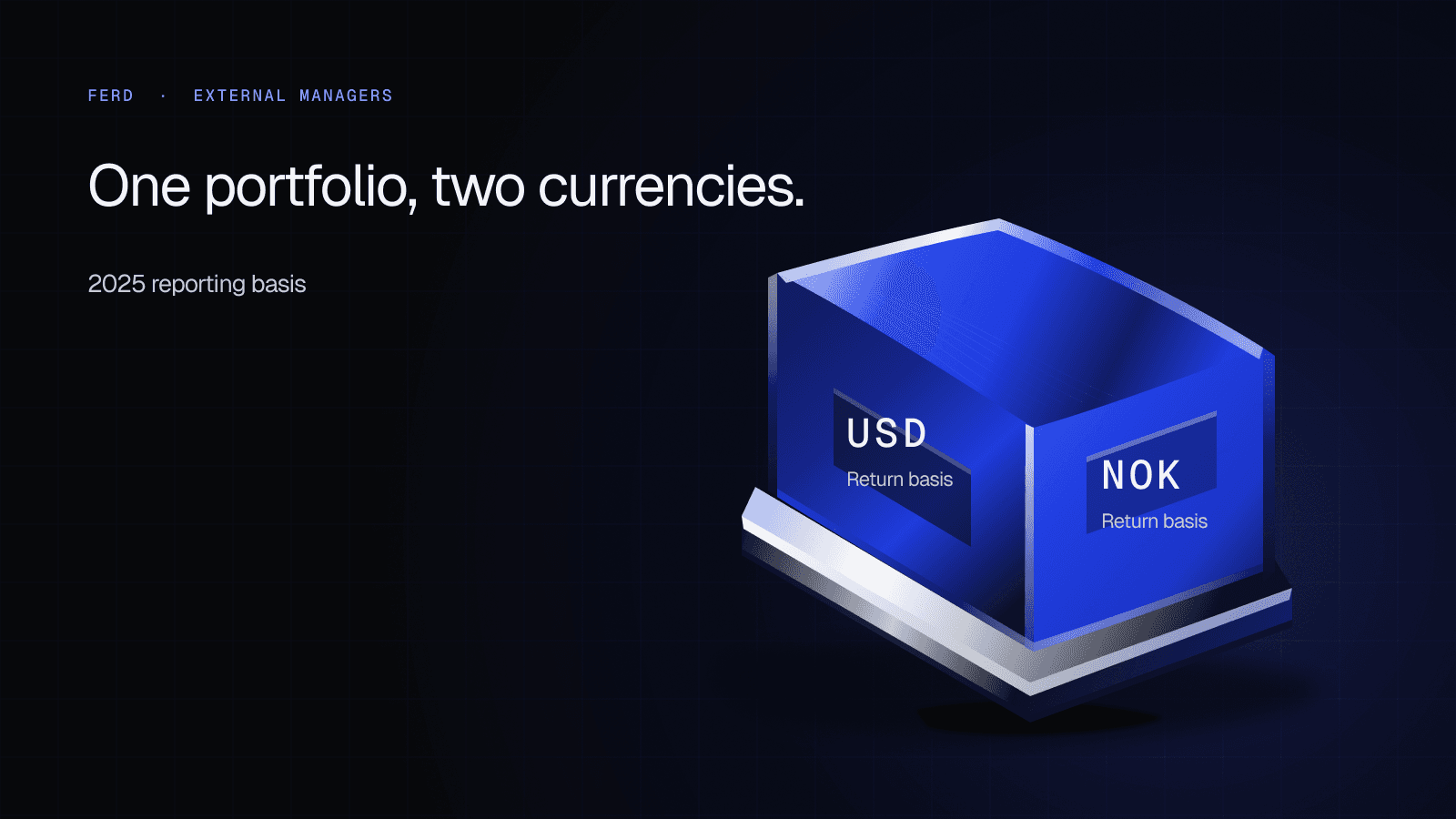
External Managers had NOK 8.6 billion under management at the end of 2025, invested with 15 managers: NOK 5.0 billion in Global Equity and NOK 3.6 billion in Global Fund Opportunities. Ferd reports those portfolio sizes in kroner while accounting for and managing the portfolios in US dollars.
The mandates returned 16.5% in USD in 2025. Measured in NOK, the return was 3.5%; Ferd attributes the difference to the krone strengthening against the dollar. Both figures describe External Managers’ performance. A consistent reporting currency is essential when comparing managers, while the NOK result shows the translated contribution to the owner. The two returns alone do not identify a hedge policy or a precise exchange-rate movement.
The NOK 8.6 billion is existing capital under management across equity and absolute-return mandates. It is neither an exclusively private-equity fund portfolio nor a disclosed new-manager allocation budget.
Climate funds have a separate route
Ferd Impact Investing focuses on early-phase companies across climate sectors for a net-zero future. The annual report’s Impact section says it primarily invests through funds and makes direct company investments by co-investing with its fund managers. An external fund relationship can therefore sit within a sector-focused programme as well as the general External Managers business.
At December 31, 2025, Impact had invested NOK 870 million in current investments and committed a further NOK 470 million. These programme-level amounts cover existing investment and commitment exposure; the paragraph does not split them between funds and companies or announce an available ticket.
Company ownership is another relationship again. Ferd’s Capital chapter separates private-company investments, including Aibel, from listed holdings such as Elopak. An operating company seeking an ownership partner and a fund manager offering a strategy address different needs.
The relevant distinction also appears in KIRKBI’s investment and climate activities. Ferd’s performance disclosures add another useful test: identify the mandate’s purpose, its reference and its reporting currency before judging the result or proposing a manager relationship.