
Reading Q3 2026 fund amendments: two reported-sales comparisons
Two Q3 fund amendments are compared with their explicitly linked predecessors, preserving reported-sales differences, dates and the limits of a fundraising-flow inference.
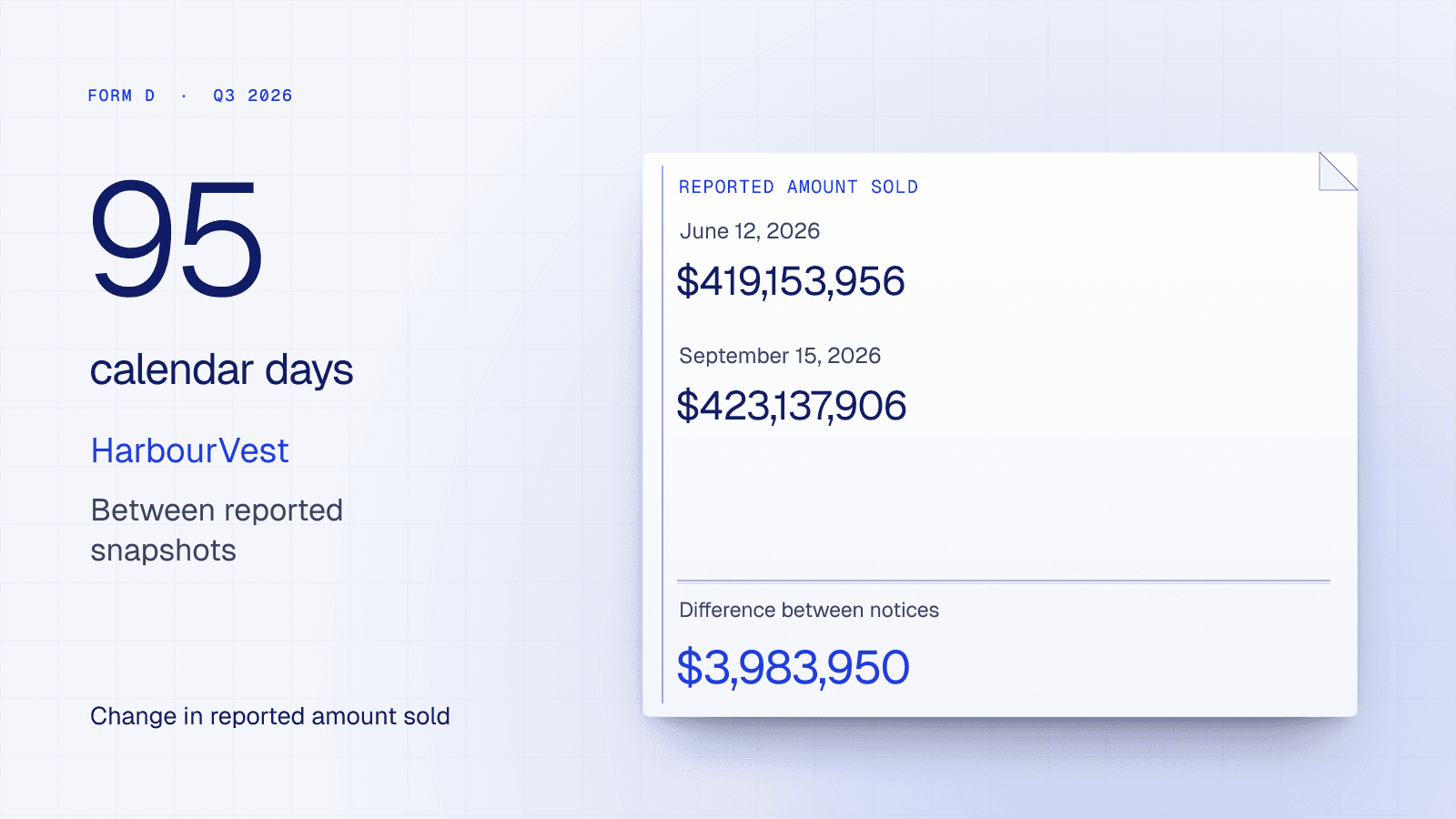
Coverage period: July 1–September 30, 2026. Earlier predecessor records are comparative context, not Q3 cash flows.
A private-fund amendment can show a large amount sold without showing how much money arrived during the quarter in which it was filed. The useful comparison starts with the earlier notice that the amendment explicitly identifies, then checks whether the issuer and offering basis still match.
Two selected Q3 2026 amendment pairs illustrate the distinction. HarbourVest Infrastructure Income Cayman Parallel Partnership L.P. reported a $3,983,950 increase between its June and September notices. Blackstone Strategic Opportunity Fund L.P. reported a $261,750,000 increase between notices filed almost a year apart. These are differences between reported snapshots, not independently verified quarterly inflows.
What was compared
This review covers two deliberately selected pooled-fund amendments and their explicitly linked predecessors: four SEC submissions. It is neither a complete amendment inventory nor a ranking of fundraising success. The selection provides two different reporting intervals without combining unrelated funds into a market total.
For each pair, the legal issuer name, primary CIK, reported first-sale date, fund classification and indefinite offering-amount basis match. Neither pair lists additional issuers in the reviewed issuer-list field. That check does not establish that the wider manager has no parallel vehicles. Dollar figures below follow the filings' USD presentation.
The distinction between an original notice and an amendment also matters. The SEC's Form D FAQ describes amendments for material corrections, relevant information changes and annual updates of continuing offerings. It says amendments must answer all items using current information when filed. Changes solely in amount sold or remaining do not themselves require an amendment. A reader therefore cannot assume that every new subscription immediately produces a new public notice. SEC Form D FAQ.
HarbourVest: a 95-day comparison
HarbourVest Infrastructure Income Cayman Parallel Partnership L.P.'s September 15, 2026 amendment, accession 0001931064-26-000004, identifies 0001931064-26-000003 as its previous accession. That earlier amendment was filed June 12, 2026.
The June notice reports $419,153,956 sold; the September notice reports $423,137,906. Subtraction gives $3,983,950 over the 95 calendar days between filing dates. Both notices report 31 investors, an indefinite offering amount and June 17, 2022 as the first-sale date.
The practical observation is narrow: the reported amount-sold field increased while the reported investor count stayed unchanged. The notices do not identify the investors behind that comparison. They cannot establish that precisely the same 31 investors remained, or that the change came entirely from additional commitments by existing investors.
The interval also starts before Q3. Assigning the entire difference to July through September would introduce a timing claim absent from the two snapshots.
Blackstone: a 364-day comparison
Blackstone Strategic Opportunity Fund L.P.'s August 14, 2026 amendment, accession 0000902664-26-003470, identifies 0000902664-25-003714 as its previous accession. The predecessor was filed August 15, 2025.
Reported amount sold rises from $878,225,838 to $1,139,975,838, a difference of $261,750,000 across 364 calendar days between filing dates. Reported investor count rises from 56 to 59. Both notices retain an indefinite offering amount and July 1, 2011 as the first-sale date.
Those dates make a Q3 fundraising interpretation especially unsuitable. Most of the comparison interval falls outside Q3 2026. The increase in investor count is also a change in a reported total, not evidence that exactly three new LP relationships were added without any departures.
Although the filings are nearly a year apart, that spacing alone does not establish why this particular amendment was submitted. The reviewed notice does not state an amendment reason.
How to use an amendment comparison
Keep the newer accession, stated predecessor, both filing dates, first-sale date and exact amount-sold fields together. Reconcile additional issuers and any clarification before calculating a difference. If the reporting basis changes, a mechanically correct subtraction may still be an unhelpful comparison.
Label the result as a change in reported amount sold between two notices. Keep it separate from fund AUM, investment performance, net subscriptions and cash received. The two comparisons here do not provide those measures, and they are not a check that no later notice exists.
For a fundraising watchlist, this creates a useful research lead with a visible evidence trail. A confirmed close, launch or current available allocation would require evidence addressing that separate question. The Altss Form D glossary provides context for reading the notice itself.


See the allocators behind your next close.
Public records carry source-specific dates where available. No population-wide measured refresh cadence or universal verification deadline is established here. Page modified, source captured, fact observed, entity verified and aggregate measured describe different events. Check the date attached to the relevant claim; a missing verification date means unknown. Stored source history does not establish a customer-facing historical-analysis interface.