
Healthcare fund announcements in Q3 2026: biotech, health technology and buyouts
Compare LumaBio I, CBIV Fund II and ARCHIMED MED IV: scientific development, health-technology commercialization and control-led healthcare growth.
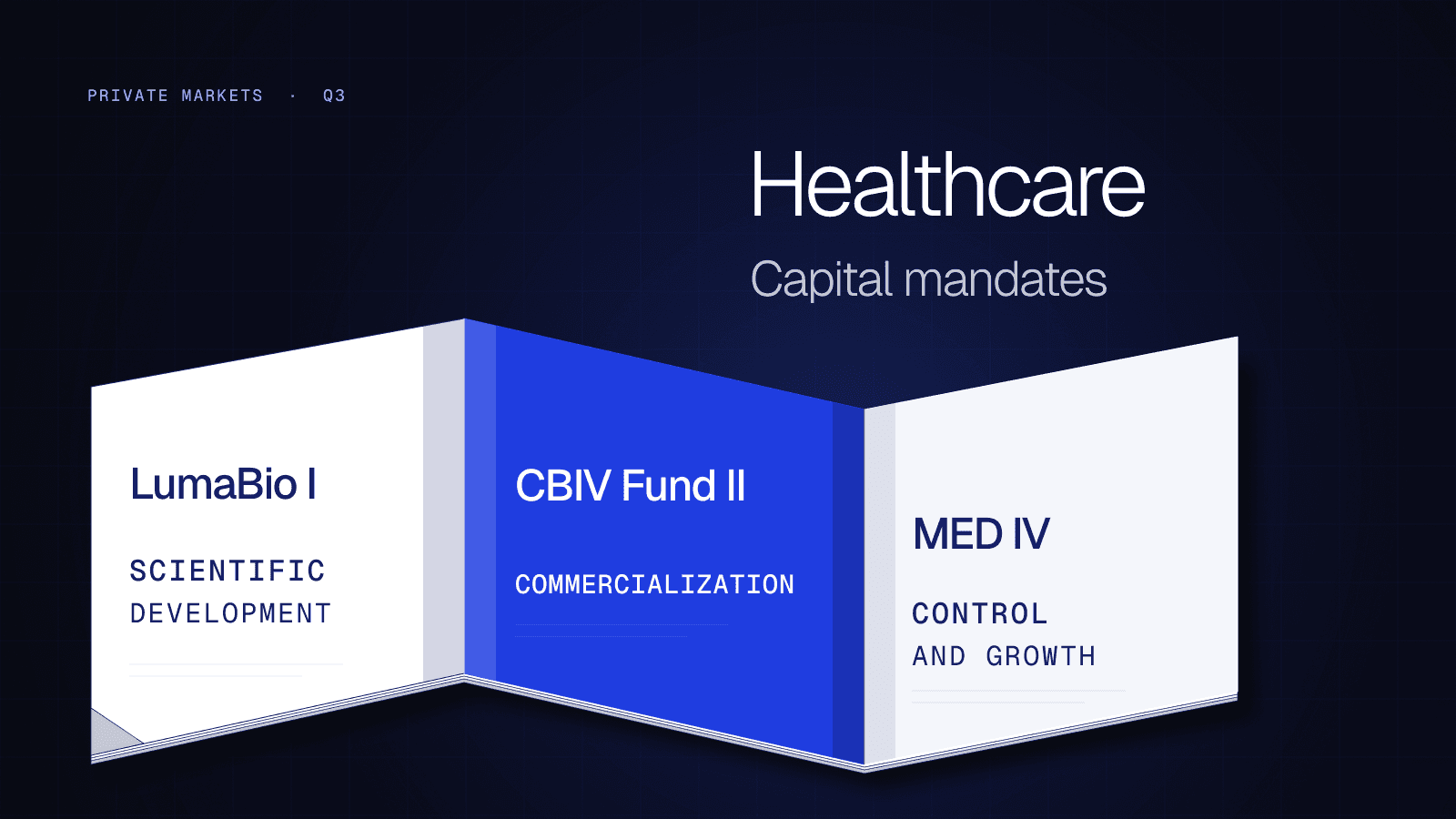
LumaBio I's $410 million final close and ARCHIMED MED IV's €1.5 billion final close put new capital behind very different healthcare investment models. Luma described a 15-year vehicle that plans to invest early and support companies from discovery through commercialization. MED IV will primarily pursue majority-control investments, with an approach centered on growing profitable healthcare businesses.
Between those models sits another distinct mandate. Cross-Border Impact Ventures announced a US$58 million first close for its Women's and Children's Health Technology Fund II, toward a US$125 million target. Its focus combines a defined health need with early-growth-stage technologies approaching commercialization. For a company seeking capital, or an LP evaluating specialist managers, the consequential comparison is the work the capital is expected to perform.
LumaBio I: scientific development with a long investment horizon
Luma Group's September 9 announcement identifies LumaBio I LP as its inaugural life-sciences venture fund. The firm says the 15-year structure gives it flexibility to support its highest-conviction companies through important milestones from discovery to commercialization. The duration is an explicit part of the financing proposition.
That proposition suits a diligence discussion organized around scientific progress and subsequent funding needs. A founder approaching the manager can explain what the proposed investment would establish, what the next milestone requires and how later capital could support continued development. The manager's stated ability to remain involved is relevant to that discussion; the amount raised alone says little about how support would be allocated among companies.
An LP has a related portfolio-construction question. The capacity to invest early and continue backing selected companies makes initial commitments and follow-on decisions part of the same underwriting problem. The investor needs to understand how the manager balances new investments with capital for existing holdings, and how scientific milestones inform those choices. A long vehicle life provides time for the strategy; assessing the investment case still requires evidence of selection discipline and capital allocation.
The announcement dates the fund's inception to 2023 and identifies an existing portfolio, including Aeovian Pharmaceuticals and Arsenal Biosciences. The September final close therefore describes a fund with investment history, rather than a blank portfolio awaiting its first company. That distinction complements the timing questions in Altss's venture-fund announcement analysis: the date of a public fundraising milestone and the development of a portfolio need to be assessed separately.
CBIV Fund II: commercialization for a defined health need
CBIV's August 6 first-close announcement describes companies addressing conditions that affect women and children specifically, differently or disproportionately. The manager identifies Series A or B as its investment stage, while also saying Fund II may invest earlier in some high-potential companies. The stage preference is meaningful without being an absolute eligibility rule.
Fund II's stated focus covers early-growth-stage companies commercializing medical devices, diagnostics, therapeutics and AI-enabled digital health technologies. A company should therefore demonstrate both why its technology fits the health mandate and what needs to happen commercially. A broad claim to be a healthcare or AI business leaves those two parts of the investment case unresolved.
CBIV describes support extending to regulatory and market expansion strategies, non-dilutive funding, governance through board participation and access to underserved markets. These are concrete areas for an LP to investigate when assessing the manager's resources, and for a company to address in a financing discussion. The prospective support connects technical progress to the practical work of commercialization.
The fundraising stage also matters to that discussion. At the August announcement, the manager had secured US$58 million toward its US$125 million objective and expected a final close in 2027. Those figures describe a first-close position and an intended subsequent milestone. An allocator can ask how the investment plan would operate at different fundraising outcomes, including the balance between new positions and support for companies already backed. The target is a planning assumption to test, rather than capital already reported as committed.
MED IV: control capital for profitable healthcare operators
ARCHIMED's September 9 release announces MED IV's final close at its €1.5 billion hard cap. The strategy primarily involves majority-control transactions alongside founders, families and management teams. ARCHIMED describes its value-creation approach as accelerating the growth of profitable healthcare leaders through international expansion, innovation, operational scaling and buy-and-build activity.
Its September announcement also says the fund launched in January and closed in less than six months; it does not specify a separate closing date.
For an owner considering a transaction, that changes the financing conversation. The proposal includes the ownership arrangement and the operating plan: which markets the business could enter, how it could scale and what acquisitions could contribute. Scientific or technical differentiation can remain important, but the disclosed strategy centers on developing an operating business through a control investment.
The manager's prioritized sectors include diagnostics, healthcare IT, life-science tools and services, and MedTech. Some labels overlap with venture portfolios. A diagnostics company can therefore appear in either a commercialization discussion or a control-buyout discussion; its development stage, business economics and proposed ownership transaction determine the more relevant comparison.
For an LP, the practical diligence moves toward the relationship between acquisition underwriting and execution capacity. International expansion and buy-and-build require a credible account of how the manager supports the businesses it acquires. The original company mandate belongs beside the fundraising figure, as it does in Altss's comparison of Q3 buyout closes.
Underwrite the capital plan and the operating requirement together
For an LP, this comparison defines the exposure under consideration. Long-duration scientific development, commercialization and control-led operating growth can share sector vocabulary while demanding different manager capabilities and portfolio plans. Fund documents and diligence still need to establish check sizes, reserve policies, governance and follow-on arrangements; the announcements do not disclose those contractual details consistently.
The strongest financing brief links each requested use of capital to the evidence already available and the next decision the investor must make. For specialist healthcare funds, that means putting the scientific milestone, commercialization requirement or ownership transaction at the center of the proposal before discussing the scale of the manager's raise.


See the allocators behind your next close.
Public records carry source-specific dates where available. No population-wide measured refresh cadence or universal verification deadline is established here. Page modified, source captured, fact observed, entity verified and aggregate measured describe different events. Check the date attached to the relevant claim; a missing verification date means unknown. Stored source history does not establish a customer-facing historical-analysis interface.