
GBL after Sienna: sold managers, retained fund investments
GBL’s Sienna management-business disposals left fund investments inside GBL Capital. Its runoff policy changes the meaning of those continuing relationships.
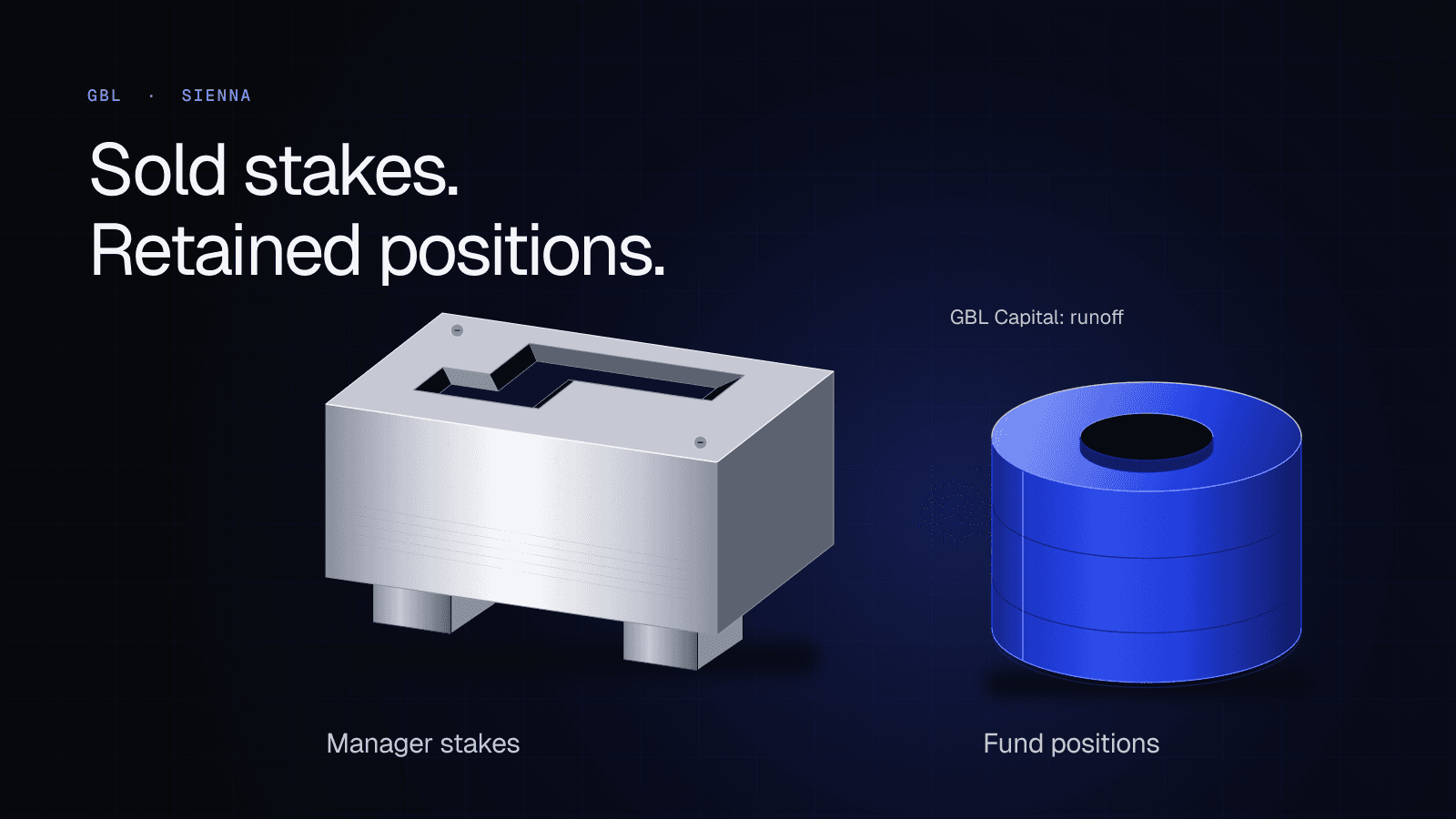
GBL sold stakes in four Sienna management businesses during the first half of 2026, yet its June 30 investment book still contained €214.0 million of Sienna-branded funds and co-investments. Those positions sat within GBL Capital, an activity the group said it was winding down without new commitments. Selling a management business and retaining an investment in one of its funds are separate transactions; the same brand can remain in an investor’s portfolio after the ownership relationship changes.
For a private-markets manager assessing GBL, that distinction changes the meaning of the disclosed relationship. A continuing fund balance establishes existing exposure. GBL Capital’s explicit policy explains why that history should not be treated as an active programme for selecting new funds. The conclusion is specific to GBL Capital, while GBL’s separate direct-company investments show a different use of its capital.
GBL’s half-year report covers June 30, 2026. Its July 30 announcement identifies it as a listed investment holding company supported by a stable family shareholder base. The analysis concerns that dated portfolio and the transaction stages disclosed with it, rather than an estimate of a family’s wealth or an October allocation budget.
Selling the manager leaves a different fund relationship
The report records the sale of GBL’s stakes in Sienna Real Estate in February 2026, Sienna Gestion and Sienna Private Credit in May, and Sienna Private Equity in June. It describes an exit from third-party asset management, with an exception for Ver Capital. That is a change in ownership of management businesses.
The detailed GBL Capital NAV nevertheless lists €128.5 million of Sienna Private Equity, €77.0 million of Sienna Venture Capital and €8.5 million of Sienna Private Credit at June 30. The report groups these as Sienna-branded funds and co-investments, totalling €214.0 million within GBL Capital’s €950.2 million NAV.
Sienna Private Equity therefore appears in two different disclosures: a management-company stake sold during June, and a retained position in the funds and co-investments category at the reporting date. The disposal and the continuing exposure can coexist. Treating the fund line as proof that GBL still owned the same management business would merge two separate assets.
GBL’s valuation glossary makes the distinction explicit. It values the Sienna Investment Managers category at the fair market value of acquired management companies. For GBL Capital, it uses the fair value of investments, notably from fund-manager information, together with external net cash or debt. Neither definition turns the investment-company portfolio into a measure of client assets under management.
Runoff still has an investment book
The decisive policy appears in the report’s introduction to GBL Capital. It says GBL announced in Q4 2025 that it had launched a sale of a significant portion of the assets and that GBL Capital would no longer make new commitments. It adds that GBL had continued to wind down its positions and would exit the activity over time.
The historical sale also transferred a funding obligation. The report’s disposal footnote records €1.7 billion of proceeds from a significant portion of GBL Capital assets sold at year-end 2025, alongside €0.6 billion of unfunded commitments transferred. The latter amount describes commitments that moved with the transaction, separately from the proceeds; it is not an additional cash reserve for another manager.
Runoff does not make the remaining portfolio inactive. GBL Capital’s detailed table records a €17.8 million net movement in its Investments column during the first half, as well as the closing positions. Its label is investments, not new fund commitments. This table does not allocate that total to a complete schedule of capital calls or establish that no further funding can be required. The policy decision and subsequent activity in existing positions are different questions.
That differs from a continuing programme such as Sofina’s disclosed fund portfolio and uncalled commitments. An analyst needs the investor’s actual commitment policy alongside the retained fund history. For GBL Capital, the history sits within a stated exit strategy, so it provides context for existing relationships rather than evidence of a newly available allocation mandate.
New company investments follow another route
GBL’s report pairs portfolio simplification with a focus on controlled and co-controlled direct private assets. Its July 30 release says the acquisition of a co-controlling stake in ophthalmic MedTech company Rayner closed on May 28. The report identifies CVC alongside GBL. The same release says its acquisition of a controlling stake in BUKO Group, a temporary traffic-management business, closed on July 8, after the June 30 balance-sheet date.
These are ownership investments in operating businesses. A company-investment case addresses the business, its development and the proposed ownership relationship. It reaches a different decision from a new commitment to an external fund. GBL Capital’s runoff policy should therefore retain its named subject rather than become a claim that the whole investment company stopped investing.
Investor AB’s company capital, manager shareholding and fund funding show those relationships continuing together. GBL supplies a different case: the sale of management businesses and withdrawal from an indirect private-asset activity, while selected company acquisitions continue.
For a manager evaluating GBL, the retained Sienna balances are evidence of exposure being managed through that exit. Rayner and BUKO illustrate the separate company-ownership cases GBL was selecting. The commercially useful profile connects each relationship to the activity behind it, rather than presenting the Sienna name or the size of a residual portfolio as a new-fund opportunity.